History at the Center
Using History at the Center of the Curriculum
Reasons, methods, and resources
(a very brief overview!)
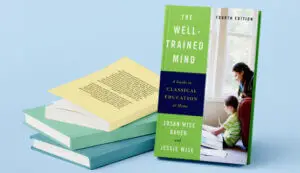
In The Well-Trained Mind: A Guide to Classical Education at Home, we recommend making history the backbone of classical studies. The study of history occupies the center of the curriculum. Reading assignments, writing, research, and even history are organized around the time period under study in history.
Why give history this central role?
Classical schoolmaster David Hicks writes, in his book Norms & Nobility:
The eclectic curriculum of the modern school…aggravat[es] the young person’s sense of helplessness and confusion in the face of a growing mass of information and opinion. Because of his cluttered, disorderly mind — helpless to make the fundamental connections between basic ideas, or to find reference points for its inchoate sensibilities — the young person cannot participate intelligently in the public debate over the great issues confronting his nation and his times….The beauty of the classical curriculum is that it dwells on one problem, one author, or one epoch long enough to allow even the youngest student a chance to exercise his mind in a scholarly way: to make connections and to trace developments, lines of reasoning, patterns of action, recurring symbolisms, plots, and motifs.
David Hicks suggests that you can bring order the mass of knowledge a student must learn by studying history, in chronological order, and relating other fields of study to this core material. History is well suited for this role, because history is simply the account of everything humanity has done, thought, invented, and dreamed about since the beginning of time. As filmmaker Ken Burns observes, no type of knowledge can be studied apart from history. The literature of the past, science and its progressive discoveries, the music of the masters — all of these are historical in nature.
What is the best way to study history?
You should begin any story at the beginning, and progress towards the end! So start studying history with ancient times, and move chronologically forward. We suggest that you divide history into four divisions:
Ancients
BC 5000 to 400 AD
Medieval/Early Renaissance 400-1600 AD
Late Renaissance/Early Modern 1600-1850 AD
Modern Times
1850-Present Day
and spend one year on each division. If you begin to do this in first grade, the student will study all of history three times: in elementary school; in greater depth in middle school; and, finally, by using original sources in the high school years.
In the elementary years, use a good world history such as the Usborne IllustratedHistory of the World. Together, read a section from the history book. Then:
1) Make a narration page, where the child tells you about what you’ve just read and you write it down (for first and second graders — by the end of second grade, the child should be writing down his own narrations);
2) Ask the child to illustrate what he’s just read, and help him to make a caption for the page;
3) Find the geographical area under discussion on the globe and map, and color the appropriate black-line map; and
4) Go to the library to find out more.
During grades 5-8, the student should start to fit all of this historical information into an overall framework. We suggest the use of a more complex history such as the Kingfisher Illustrated History of the World. The middle-grade student should follow this process:
1) Read and outline a section from the History of the World
2) Mark all dates on a time line
(note on the timeline above that current dates are more detailed than dates from the Ancients time period)
3) Find the region under study on the globe, the wall map, and in the atlas
4) Do additional reading from the library (or from the Resources list)
5) Prepare summaries of information on at least two of the above topics and file them in a History Notebook. In fifth grade, these will be simple outlines; by eighth grade, these summaries will be compositions, two to four pages long.
The History Notebook is simply a fat three-ring binder, full of notebook paper. Label this notebook with the period under study (for example, Ancients: BC 5000 to 400 AD) and divide it into nine sections. Mark the dividers with the following topics:
1) Outlines
2) Great Men and Women
3) Wars, Conflicts, and Politics
4) Inventions and Technology
5) Religion
6) Daily Life
7) Cities and Settlements
Primary Sources
9) The Arts and Great Books
File each student composition under the appropriate division.
During the elementary and middle school years, the student should be reading imaginative literature written during the period under study in History (we supply extensive, age-appropriate lists in The Well-Trained Mind).
During the high school years, the student should go directly to original sources to study history and literature. We suggest the use of a Great Books list along with a brief summary of world history (such as the Short History of Western Civilization). For each text on the Great Books list, the student should follow this pattern:
1) Create a context page. Glance at the appropriate pages in a chronology book (we like The Timetables of History). Read the corresponding section in the Short History of Western Civilization. Then, write a one-page summary setting the book in historical perspective. Give basic information about the author, his times, his country, and his purposes in writing; summarize great events going on in the rest of the world. File this page in a History Notebook behind a divider marked Context. As you progress through the lists in chronological order, this section will begin to resemble a one-volume world history in its own right.
2) Read through the text, pencil in hand, using techniques suggested in Mortimer Adler’s How to Read a Book. File all the notes you take on the book in a section of the History Notebook labelled “Great Books.”
3) Discuss the text. Talk about its purposes, its strengths and weaknesses. Have a conversation about the ideas and whether or not they are valid.
4) Write about the text. This is a flexible assignment; you can write a book report, an evaluation, an argumentative essay proving some point about the book, or an analysis of the book’s ideas. Put the finished composition (at least two pages) in the Compositions section of the notebook.
For detailed, step-by-step instructions and complete resource lists, see The Well-Trained Mind: A Guide to Classical Education at Home.
Go back to the complete article index.