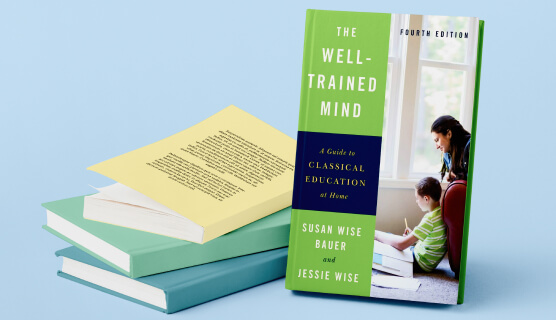
PREPARING FOR COLLEGE Copyright 2000 by the author. Please do not reproduce. This material is adapted in part from The Well-Trained Mind: A Guide to Classical Education at Home, which contains much more information on this topic.
Susan Wise BauerCOURSE OF STUDY
The student must fulfill a number of minimum credits in order to graduate from high school. Traditionally, one credit of high school equals 120 hours of class work, or 160 45-minute periods. Typically, twenty credits are required for graduation:
Language Arts 4
Mathematics 2
Science 2
American History 1
American Government 1
Physical Education 2
Electives 8
A college preparation course is more extensive, typically requiring the following:
Language Arts 4
Mathematics 3-4
Foreign Language 2-4
World History 1
American History 1
American Government 1
Science 3-4
Physical Education 2
Electives 4-8DOCUMENTING YOUR COURSE OF STUDY
HIGH SCHOOL: TRANSCRIPTS
Subjects studied
Years of study
Units of credit
Final grades (per semester)Achievement test scores
Extracurricular activitiesRESOURCES
Rainbow Resource Center (1-888-841-3456) offers The Homeschooler's High School Journal, 7-12. Records test scores, time spent on each subject and time spent on field trips or research, library list forms (so you can keep track of what you've read), a chart so that you can keep track of weekly hours in each subject, and a grade record.Daily Planner from Scholastic is a basic record book to keep track of dates, assignments, field trips, and grades in K-12. Buy from The Home School (1-800-788-1221) for $4.95.
You can order a standard high school transcript form, published by the National Association of Secondary School Principals, form the Home School Resource Center (1-800-937-6311) for $1 each. Get several in case you make a mistake.
You can order a diploma from HSLDA for $20 by calling 1-540-338-5600. It has a psalm on it; if you want a plain diploma, you can often find blank diplomas at art stores or large office supply stores.
APPLYING TO COLLEGE
STANDARDIZED TESTING
AP AND CLEP
Advanced Placement and College Level Examination Program exams are both administered by the College Board, which offers 34 CLEP exams and AP exams in twenty different areas of study.
Call (212) 713-8165 or go to the website, www.collegeboard.com
Specific AP information: (888) CALL-4-AP or (609) 771-7300.
Specific CLEP information: (609)951-1026PSAT, SAT AND ACT TESTS
The PSAT, the SAT, and the ACT are all standardized high school achievement/skill evaluation tests, used by colleges to sort through and rank applicants.
Finish as much math as possible before the junior year.
Study Latin.
Use Vocabulary from Classical Roots
Read Mortimer Adler's How To Read a BookThe PSAT -- Preliminary SAT/National Merit Scholarship Qualifying Test -- is adminstered by the College Board and is taken during the sophomore or junior year of high school. Questions about National Merit scholarships should be directed to the National Merit Scholarship Corporation at (847)866-5100. It is given ONLY in October.
The SAT, the standard college admissions test, has two parts. The SAT I is the test everyone takes; it takes three hours and has seven sections divided up among verbal, mathematical, and analytical problems. The SAT II or Subject Tests are optional, but home schoolers should strongly consider taking as many as they feel prepared for (some colleges require them for home schoolers). The tests are one-hour, multiple choice, and measure knowledge in specific content areas.
Take the SAT in the fall of the senior year.
To register for the SAT, call (609)771-7600 and ask for a Registration Bulletin. When it comes, fill out the registration form and send it back by mail. Home schooled students use the "universal home school code" listed in the Registration Bulletin -- 990599. You can also register online (www.collegeboard.com).FOR BOTH THE PSAT AND SAT, MAKE SURE GEOMETRY HAS BEEN FINISHED BEFORE TAKING THE TEST FOR HIGHEST SCORE.
The four ACT tests cover English, mathematics, reading, and science reasoning. The test is three and a half hours long. It's given five times -- in October, December, February, April, and June -- and costs $20. For full information about the ACT, visit their online site at www.act.org. You should take the ACT in the spring of your junior year. For registration and location information, call 1-800-525-6926.
AP and CLEP resources
For College Board resources and information about AP and CLEP exams, visit their website at www.collegeboard.com; you can also get AP information by calling (888)CALL-4-AP or (609)771-7300.The Barron's How to Prepare for the AP series of test-taking includes reviews, test tips, lots of practice, and sample tests.
Calculus, English Literature and Composition, Chemistry, Physics B, European History, Statistics, Spanish, French, Biology, English Literature and Composition, United States History, U.S. Government and Politics
Research Education Associates publishes the following AP review guides:
Advanced Placement Computer Science Exam
Advanced Placement Chemistry Exam
Advanced Placement Physics Exam
Advanced Placement English and Composition
Advanced Placement European History
Advanced Placement StatisticsAlso the following CLEP guides:
CLEP Analysis and Interpretation of Literature
CLEP College Algebra
CLEP Freshman College CompositionPSAT/SAT resources
For the SAT Registration Bulletin or questions: Call ETS at 888-225-5427 (general number) or (609)771-7600 (Bulletin request), or visit the College Board website at www.collegeboard.com.For National Merit Scholarship information, contact the National Merit Scholarship Corporation at 1560 Sherman Avenue, Suite 200, Evanston, IL 60201-4897, telephone (847)866-5100
Barron's SAT series:
How To Prepare for the SAT I
Passkey to SAT I
Passkey to the PSAT NMSQT
SAT II
SpanishThe Princeton Review series has a long track record of success:
Inside the SAT
SAT Math Workout
SAT Verbal WorkoutIf you plan to take the SAT II, you should look at the guide published by the College Board:
The Official Guide to the SAT II: Subject TestACT resources
For ACT information, contact ACT at www.act.org, call them at (800)525-6926, or write ACT Test Administration, P.O. Box 168,
Iowa City, IA 52243-0168.Barron's publishes the following ACT preparation guides:
Pass Key to the ACT, part of the Pass Key series.
How to Prepare for the ACTGENERAL THOUGHTS ON ADMISSIONS
An application will give you room to describe your areas of interest, extracurricular activities, and any special research projects you've done. Maximize your application by using the lines set aside for interests, activities and clubs to emphasize your language accomplishments and great books study. Make sure you describe the junior and senior thesis projects, which will set you apart from most high school students. List all community service projects -- anything you've done free that benefits someone else.
THE PORTFOLIO
1) A narrative description of your high school studies, written by the student.
2) A reading list of all significant books read (from about 7th grade on).
3) At least one writing sample.
4) A description of any academic contests and honors.
5) Descrptions of any apprenticeships, interesting work experiences (not McDonalds), or internships.
6) A brief description of any special area of expertiseONE SUCCESSFUL APPLICATION
1) SCHOOL PHILOSOPHY -- A one-page statement written by Peggy about why she taught her daughter at home, including her summary of their use of the Trivium.
2) CHARACTER PROFILE -- A brief assessment written by Peggy, using comments from teachers, friends, relatives, and siblings.
3) STUDENT ASSESSMENT OF HOME SCHOOLING -- Written by Peggy's daughter; a 1-page critique of her homeschool experience, including both positives and negatives.
4) CURRICULUM DESCRIPTION -- A narrative description of each course done in high school, written by Peggy. According to Peggy, this turned out to be 13 pages long -- much longer than necessary for most home schoolers.
5) TEACHER EVALUATIONS -- Copies of evaluations given to Peggy by some of her daughter's other tutors.
6) SAMPLE PAPERS -- Three papers written by Peggy's daughter. (One is sufficient for most portfolios.)
7) READING LIST -- All the books read by Peggy's duaghter since eighth grade.
8) MUSIC ACHIEVEMENT -- Details of competitions, master classes, recitals, and a tape. You could use this section for any major achievement.RESOURCES
General guides to colleges
The College Handbook (College Board). Includes admission policies, requirements, and deadlines; ACT and SAT test dates; enrollment figures and majors; campus life, including sports and student services, and much more. Updated annually.Peterson's Guide to Four-Year Colleges (Peterson's). Good, standard annual guide colleges; comes with CD-ROM so you can also search electronically.
Published by Barron's Educational Services; get the most recent version:
Barron's Best Buys in College Education by Lucia Solorzano.
Barron's Compact Guide to Colleges, by Tessa Krailing
Barron's Profiles of American Colleges, divided by
geography (Northeast, Southeast, etc.)The Princeton Review Student Advantage Guide to the Best 310 Colleges (Random House) uses counselor surveys and information from an independent research firm to pick out academic stars in the college galaxy.
Peterson's Competitive Colleges (Peterson's) lists colleges which admit high achievers; this is based largely on SAT scores and grades.
Guides to procedures:
Choosing the Right College; The Whole Truth about America's 100 Top Schools, by William J. Bennett (Eerdman's, 1998) An "intellectual road map" to thinking through the college decision.
The Admissions Essay: How to Stop Worrying and Start Writing. Clear and Effective Guidelines on How to Write That Most Important College Entrance Essay, by Helen W. Power, and Robert Diantonio (1992).
And What about College?: How Homeschooling Leads to Admissions to the Best Colleges and Universities (Holt Associates, 1997), written by home school mom Cafi Cohen.
The Better Book for Getting Hired: How to Write a Great Resume, Sell Yourself in the Interview, and Get That Job (Self-Counsel Reference Series), by Robert P. Downe. (Self Counsel Press Inc., 1993).
PLANNING FOR COLLEGE
Grades 5 & 6 Plan a math sequence that will finish up Algebra 2 and geometry by PSAT time. Also plan to complete the Vocabulary from Classical Roots series, the courses in logic, and at least two years of Latin before taking the PSAT.
Grades 7 & 8 Start writing for prospective college catalogs to find out what high school requirements you must fulfill in grades 9-12. (See "Choosing a College" below)
Grade 9 Ask prospective colleges what form they prefer home school admissions to take -- a transcript, a portfolio, etc. That way, you can start your high school records in an orderly manner. If you're not sure, keep good records so that you can be flexible when application time comes. KEEP A TRANSCRIPT EVEN IF YOUR COLLEGES DON'T REQUIRE IT! You never know when you might need one.
Grade 10 Find out from a local public or private school guidance counselor when the PSAT will be given (in the fall of the 11th grade year) and how to pre-register. You can take the PSAT any time from eighth grade on, as many times as you wish, but if you're interested in a National Merit scholarship, take it only once, in the 11th grade year.
Start working through an SAT preparation guide, daily, as though you were taking an extra course.
Grade 11 Register for the SAT, to be taken in the fall of the 12th grade year.
Continue working through SAT preparation guide, daily.
Visit colleges and zero in on choices. Call admissions offices; find out when they start taking applications for early decision and regular admissions, and how to apply for financial aid. Early applications produce better aid than last-minute submissions.
Investigate taking classes for college credit. Some colleges allow students who take college courses during their senior year to apply these credits to the freshman year. Also, these classes prove that you're capable of doing college work.
Grade 12 Take the SATs.
Complete the application forms for the colleges of your choice. Get these forms and the financial aid forms in as soon as possible.
If the college conducts interviews, practice role-play interviews. You can use a guide to job interviews to check on basic skills (dress nicely, make eye contact, shake hands)
Back to Convention Handouts page
Back to The Well-Trained Mind pageus with comments!